Research focus areas. The Department’s research is multidisciplinary and combines the traditional field of industrial cardiology with modern priorities in internal medicine. In particular, the Department investigates the impact of industrial aerosol exposure and vibration on the cardiovascular and bronchopulmonary systems in machine-building industry workers. In parallel, the Department studies cardiometabolic comorbidity—including arterial hypertension, obesity, type 2 diabetes mellitus, atherosclerosis and coronary artery disease—by assessing risk factors, mechanisms of disease progression and predictors of adverse outcomes across different occupational groups.
Key scientific achievements. Over the years, the Department has conducted research within the programme “Combating arterial hypertension in the organised population (industry) of Kharkiv.” This work enables active identification of individuals with hypertension, implementation of treatment strategies, and evaluation of approaches to reduce morbidity and mortality—primarily from cardiovascular and cerebrovascular diseases. Therapeutic approaches for hypertension in industrial workers have been developed, and the role of occupational factors in its development and course has been substantiated.
A concept of vibration disease as a membrane pathology has been formulated, characterised, among other features, by impaired transmembrane calcium transport and structural changes in membrane proteins. These findings provided a rationale for pathogenetic treatment approaches, including the use of calcium channel blockers in the management of this patient category.
The Department also advances research in cardiometabolic comorbidity, focusing on mechanisms of hypertension progression in combination with obesity and type 2 diabetes and their contribution to early target-organ damage. The research applies modern approaches to risk stratification and the search for biomarkers (metabolic and inflammatory) that improve prognostic assessment and may be integrated into clinical practice.
Publications and dissemination. The Department’s scientific achievements are reflected in numerous publications in Ukrainian and international peer-reviewed journals. In 2020–2025, a series of papers was published in journals indexed in Scopus/Web of Science, including European Journal of Heart Failure, Europace, Atherosclerosis, European Respiratory Journal, American Heart Journal, Journal of Hypertension, Cor et Vasa, and others.
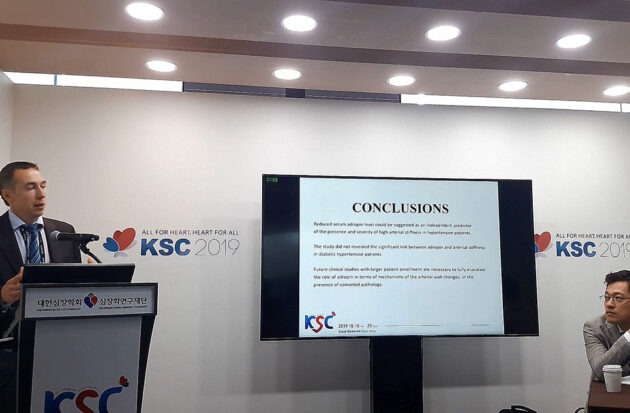
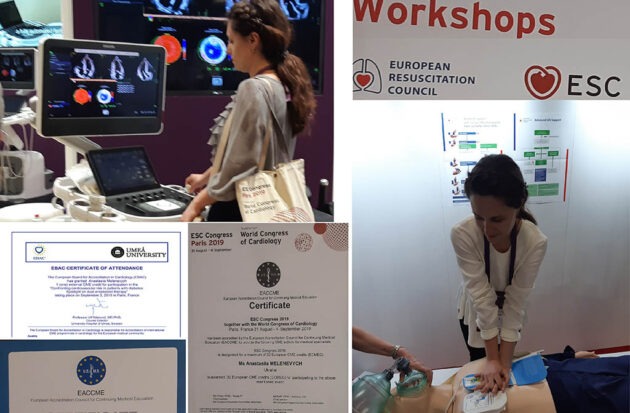
Research results are regularly presented at relevant national and international professional meetings in cardiology, pulmonology and related specialties in Ukraine and abroad, including the European Respiratory Society (ERS) Congress, the European Society of Cardiology / Heart Failure Association (ESC/HFA) Congress (including the World Congress on Acute Heart Failure), the European Atherosclerosis Society (EAS) Congress, the European Meeting on Hypertension and Cardiovascular Protection (ESH), and events of the Korean Society of Cardiology (KSC, Seoul, Republic of Korea), among many others.
Grant activity.
In 2024–2025, the Department strengthened its international research activity and received grant support from the Foundation for the Development of Internal Medicine in Europe (FDIME) to implement a research project in the field of cardiometabolic pathology. The grant is aimed at strengthening the Department’s research capacity, training young researchers, and translating results into clinical practice and the educational process.
Dissertation research. As outcomes of the Department’s research activities in 2020–2025, one Doctor of Medical Sciences (DSc) thesis and two PhD (Candidate of Sciences) theses were completed and defended.